An independent AI ethics consultancy. Founded in 2008. Active in the rooms where standards are written.
BeEthical was founded before AI ethics had a name, but data ethics, digital ethics and information ethics already existed. In 2008, the questions we work on today were the concerns of a small community of researchers and practitioners who saw what was coming.
We have been working on those questions ever since. The regulatory landscape has caught up. The EU AI Act, Corporate Sustainability Reporting Directive (CSRD), and a growing body of international standards now formalise obligations that we were helping organisations navigate long before they became law.
That continuity is not incidental. It is the foundation of our work.
We are a team of four professionals working full-time, supported by a network of approximately ten specialist collaborators: researchers with industrial experience, Corporate Social Responsibility (CSR) experts, and sector specialists. We are small by design. Our model depends on direct engagement, not on delegating client work to junior staff.
We do not name the organisations we advise. Our independence is not a marketing claim: it is a structural commitment. We preserve it by keeping our client relationships confidential and by accepting only mandates where we can offer genuinely unbiased evaluations.

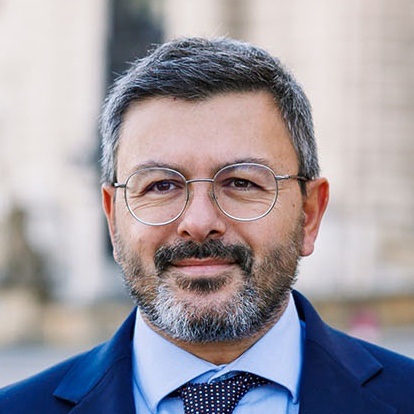
Enrico Panaï
AI Ethicist · President, Association of AI Ethicists · Convenor, CEN-CENELEC JTC21 WG4
Enrico Panaï has been working at the intersection of technology, ethics, and information since the 1990s. His entry point was not AI: it was the digital. Questions about how information systems shape behaviour, distribute power, and create moral responsibilities have occupied him for three decades. AI ethics, as a field, arrived later. The questions did not.
He holds a degree in philosophy and a PhD in AI Ethics and Cybergeography from the University of Sassari, where he taught Digital Humanities for six years. He subsequently deepened his expertise in cybersecurity at the Institut National de Hautes Études de la Sécurité et de la Justice in Paris. The combination is unusual: a philosopher with a cybersecurity background and a deep knowledge of information systems. It is also the combination that the work requires.
His standardisation roles reflect the depth of that engagement. He is Convenor of WG4 on Fundamental and Societal Aspects of AI within CEN-CENELEC JTC21, the committee responsible for supporting the implementation of the EU AI Act. He is Editor of the ISO/IEC JTC1 SC42 WG3 standard on AI-enhanced nudging. He serves on the French AI standardisation committee at AFNOR. These are not advisory roles: they are working positions that involve drafting, debating, and deciding on the language of the standards that will govern AI across Europe and internationally.
He teaches at the Catholic University of the Sacred Heart in Milan. He co-directs Future of Work with AI, in partnership with UNESCO. He is President of the Association of AI Ethicists, whose competency framework and certification scheme are shaping how the profession is defined and recognised.
His published work includes peer-reviewed research in Springer, Nature Human Behaviour, and Oxford University Press, as well as two books: Skip! The Art of Avoiding Projects (EDES, 2020) and The Ethics of Artificial Intelligence Explained to My Son (Mimesis, 2024). He translated Luciano Floridi’s The Ethics of Artificial Intelligence into French.
“Using AI Ethics, we help build the environment where ethical reasoning can flourish.”
Small enough to care. Experienced enough to deliver.
BeEthical operates with a core team of professionals working full-time across AI Ethics, Digital Corporate Social Responsibility, research, and standardisation. They bring backgrounds in philosophy, information science, law, and sustainability: the combination of disciplines that complex ethics governance work requires.
Our extended network of specialist collaborators includes industrial researchers, Corporate Social Responsibility practitioners, and sector experts who join specific mandates where their expertise is directly relevant. We do not maintain a large permanent staff to fill timesheets. We build the right team for each engagement.
Every mandate at BeEthical involves senior-level engagement throughout. We do not delegate the substantive work.
Why we remain a boutique.
Large consultancies offer AI ethics services. Most do so as one practice among dozens, staffed by generalists working from frameworks developed elsewhere.
BeEthical does one thing. We have done it since 2008. Our team contributes to the committees writing the standards that define what AI ethics governance actually means. Our research is published in peer-reviewed journals. Our methods are not proprietary: they are traceable, documented, and academically grounded.
Independence is the condition that makes this possible. We do not take mandates from organisations whose interests would compromise our ability to offer unbiased evaluations. We do not use client names to build our reputation. We do not grow faster than our capacity to deliver work of genuine quality.
That is a deliberate choice. It is also the reason our clients trust us with the decisions that matter.
The language we work in.
- Infraethics
- The foundation that shapes the conditions under which ethical action becomes possible — the AI ethics infrastructure that lets an organisation act on the values it holds.
- Soft ethics
- What ought to be done over and above existing regulation, not against it. The space where organisations exercise ethical judgement beyond mere compliance.
- Ethics-based auditing
- A structured, documented assessment of whether an AI system’s behaviour aligns with declared values and ethical principles, not only with legal requirements.
- Ethical foresight analysis
- The systematic anticipation of the ethical consequences of a technology before deployment, when change is still inexpensive.
- Pro-ethical design
- Designing systems and environments so that the ethical choice becomes the easy choice, without removing the freedom to choose otherwise.
- Moral patient
- Any entity that can be affected, benefited, or harmed by an action. In information ethics, the class of those who deserve moral consideration.
- Distributed moral responsibility
- Responsibility for outcomes produced by networks of human and artificial agents, where no single actor caused the harm alone.
- Level of abstraction
- The chosen set of observables through which a system is analysed. Ethical questions change, legitimately, with the level at which they are asked.
- Infosphere
- The whole informational environment: entities, processes, and interactions. The space in which digital action, and therefore digital ethics, takes place.
- Semantic capital
- Any content that gives meaning and value to something else. What organisations accumulate, spend, and risk when they act in the infosphere.
- Trustworthiness
- The demonstrable property of deserving trust. Trust is given by others; trustworthiness is built, evidenced, and audited.
- Explicability
- The combination of intelligibility (how does it work?) and accountability (who is responsible?). The enabling principle behind all others.
- Human oversight
- The designed capacity of humans to understand, intervene in, and override an AI system’s operation. A structural property, not a disclaimer.
- AI-enhanced nudging
- The use of AI to steer choices through choice architecture. Legitimate when transparent and reversible; manipulative when it exploits cognitive vulnerabilities.
- Ethics shopping
- Selecting, from the many available frameworks, the ethical principles that justify what one already does, rather than adjusting behaviour to principles.
- Ethics bluewashing or ethics washing
- Implementing superficial ethical measures, or advertising exaggerated ones, to appear more ethical than one is. The digital counterpart of greenwashing.
- Ethics lobbying
- Exploiting self-regulation and digital ethics to delay, weaken, or replace necessary legislation. Ethics used against the law, not beyond it.
- Ethics dumping
- Exporting unethical research or deployment practices to jurisdictions with weaker rules, then importing the results as if they were clean.
- Ethics shirking
- Doing progressively less ethical work wherever the perceived return on ethics is low: typically where victims have little voice or power.